NEET PG 2026 Revision Plan: Your Complete Rapid Revision Schedule
Preparing for NEET PG 2026 requires more than just completing the syllabus once. The real difference comes from how effectively you revise, retain, and apply concepts in the final months before the exam. A well-structured NEET PG revision plan helps you cover all 19 subjects systematically, revise high-yield topics repeatedly, and improve your performance in grand tests and mock exams.
This complete, rapid revision NEET PG schedule is designed to help you organise your preparation week by week, prioritise important subjects, and follow a practical last-minute revision strategy before the exam.

Why You Need a Structured NEET PG Revision Plan
A structured NEET PG revision plan helps you avoid random studying and ensures that every subject gets adequate revision time. Since NEET PG includes pre-clinical, para-clinical, and clinical subjects, students often struggle to balance volatile subjects like Pharmacology and Microbiology with vast clinical subjects like Medicine, Surgery, Obstetrics & Gynaecology, and PSM.
A planned revision strategy helps you:
- Revise all 19 subjects within a fixed timeline
- Identify weak areas early
- Improve recall of high-yield facts and concepts
- Practice MCQs alongside revision
- Track performance through mock tests
- Avoid last-minute panic and syllabus overload
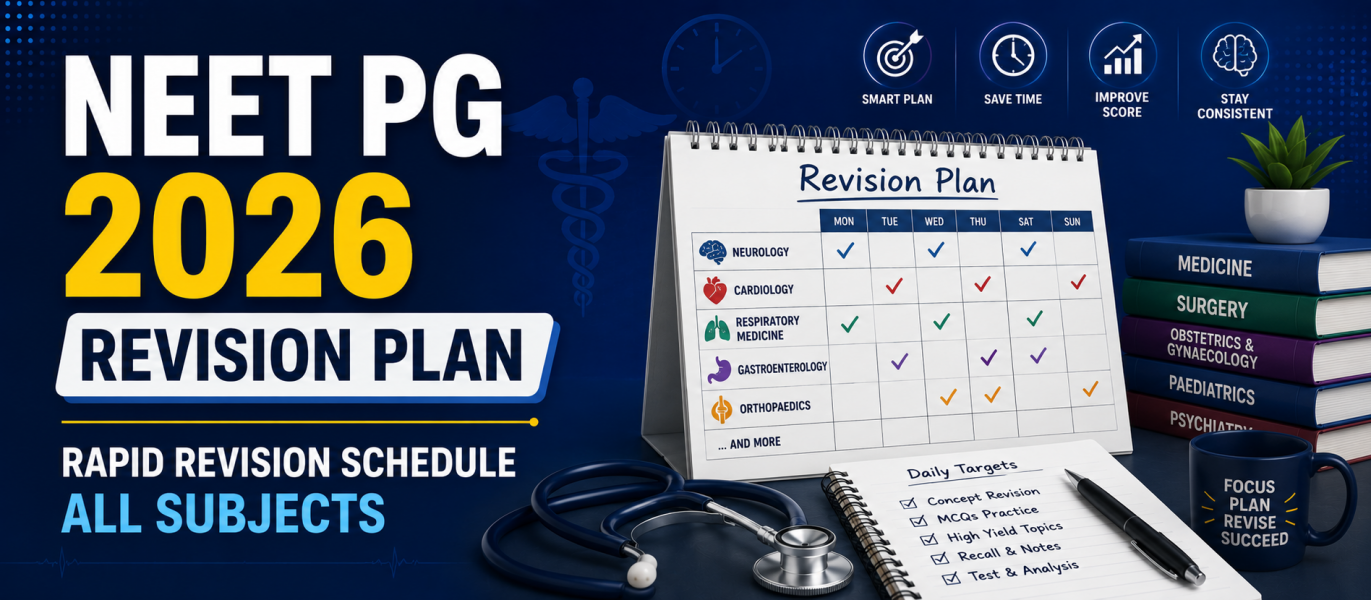
NEET PG 2026 Revision Schedule Week-by-Week
A practical NEET PG revision schedule should include subject revision, MCQ practice, mock tests, and error analysis. The following schedule can be adapted to your preparation level and the time remaining before the exam.
Week 1: Anatomy, Physiology, Biochemistry
Start with the first-year subjects, as they form the foundation for many clinical concepts.
Focus areas:
- Anatomy: Neuroanatomy, embryology, upper limb, lower limb, abdomen
- Physiology: Cardiovascular system, respiratory system, renal physiology, CNS
- Biochemistry: Vitamins, metabolism, enzymes, genetics, molecular biology
Revision strategy:
Use concise notes, diagrams, flowcharts, and image-based questions. Practice MCQs daily after each topic.
Week 2: Pathology, Pharmacology, Microbiology
These subjects are high-yield and require multiple revisions because they are fact-heavy.
Focus areas:
- Pathology: Haematology, systemic pathology, inflammation, neoplasia
- Pharmacology: Autonomic nervous system, antimicrobials, cardiovascular drugs, CNS drugs
- Microbiology: Bacteriology, virology, immunology, parasitology, mycology
Revision strategy:
Create drug tables, organism charts, and disease-marker associations. Revise previous year questions and high-yield facts repeatedly.
Week 3: Forensic Medicine, PSM, ENT, Ophthalmology
This week should focus on subjects that are scoring and manageable with focused revision.
Focus areas:
- Forensic Medicine: IPC sections, toxicology, injuries, post-mortem findings
- PSM: Epidemiology, biostatistics, national health programs, vaccines
- ENT: Ear diseases, audiometry, larynx, nose and paranasal sinuses
- Ophthalmology: Retina, glaucoma, cataract, uveitis, neuro-ophthalmology
Revision strategy:
Revise formulas, charts, staging systems, and national programs. Practice image-based MCQs for ENT and Ophthalmology.
Week 4: Medicine and Dermatology
Medicine is one of the most important subjects for NEET PG and should be revised with strong clinical integration.
Focus areas:
- Cardiology
- Neurology
- Nephrology
- Endocrinology
- Infectious diseases
- Respiratory medicine
- Rheumatology
- Dermatological lesions and syndromes
Revision strategy:
Focus on clinical presentation, diagnosis, investigations, and management. Revise algorithms and commonly tested emergencies.
Week 5: Surgery, Orthopaedics, Anaesthesia, Radiology
This week should focus on surgical concepts, trauma, imaging, and perioperative care.
Focus areas:
- Surgery: GIT surgery, thyroid, breast, urology, trauma, burns
- Orthopaedics: Fractures, bone tumours, nerve injuries, spine, pediatric orthopaedics
- Anaesthesia: General anaesthesia, local anaesthesia, airway management, complications
- Radiology: X-rays, CT, MRI, ultrasound, emergency imaging
Revision strategy:
Practice image-based questions, clinical case scenarios, and management-based MCQs.
Week 6: Obstetrics & Gynaecology and Pediatrics
OBG and Pediatrics are high-yield clinical subjects and require focused revision of protocols, milestones, and management guidelines.
Focus areas:
- Obstetrics: Antenatal care, hypertensive disorders, PPH, labour, fetal monitoring
- Gynaecology: Menstrual disorders, infertility, contraception, malignancies
- Paediatrics: Neonatology, growth and development, vaccines, genetic disorders, pediatric emergencies
Revision strategy:
Revise tables, management flowcharts, vaccination schedules, and emergency protocols.
Week 7: First Full Revision + Grand Tests
Use this week for your first complete revision cycle.
Plan:
- Revise the short notes of all 19 subjects
- Attempt at least 2 grand tests
- Analyse incorrect answers carefully
- Update your mistake notebook
- Revise the frequently asked topics again
Week 8: Final Rapid Revision
The final week should be reserved for high-yield notes, previous year questions, volatile facts, images, and test mistakes.
Plan:
- Revise high-yield tables and charts
- Review bookmarked MCQs
- Revise image-based questions
- Go through your mistake notebook
- Avoid starting new resources
- Attempt only limited tests to avoid burnout
Subject-Wise Rapid Revision Guides for NEET PG 2026
For effective, rapid revision of NEET PG preparation, it is better to revise each subject using a dedicated high-yield guide. Subject-wise revision helps you focus on the most important topics, repeated questions, and exam-oriented concepts.
Use the following subject-wise guides to strengthen your NEET PG 2026 preparation:
- NEET PG PSM Rapid Revision Guide
Last-Minute Revision Strategy
The final phase before NEET PG should focus on revision, not on resource collection. A smart last-minute revision NEET PG strategy helps you retain more and perform better under exam pressure.
- Revise Only Your Trusted Resources
Avoid starting new textbooks, notes, or question banks in the final days. Stick to your own notes, marked MCQs, grand test mistakes, and high-yield revision guides.
- Prioritise High-Yield and Volatile Topics
Focus on topics that are frequently asked and easy to forget, such as:
- Pharmacology drug classifications
- Microbiology organisms and culture media
- PSM formulas and national health programs
- Biochemistry, vitamins, and metabolism
- Forensic medicine sections and poisons
- Pediatric milestones and vaccines
- Obstetrics management protocols
- Review Your Mistake Notebook
Your mistakes are your most personalised revision resource. Go through incorrect MCQs, confusing options, and repeatedly forgotten facts.
- Practice Image-Based Questions
NEET PG often includes image-based questions from subjects like Pathology, Microbiology, Dermatology, Radiology, Ophthalmology, ENT, and Surgery. Revise images daily in the last phase.
- Do Not Overattempt Mock Tests
Mock tests are useful, but too many tests in the final week can increase stress. Focus more on analysis and revision than on test quantity.
- Maintain Sleep and Exam-Day Routine
In the last few days, sleep schedule matters. Avoid late-night cramming and try to align your study routine with the actual exam timing.
Frequently Asked Questions:
Q1. What is the best revision plan for NEET PG 2026?
Ans – The best NEET PG revision plan is one that allows you to revise all 19 subjects at least twice, practice MCQs daily, take grand tests regularly, and analyse mistakes thoroughly.
Q2. How many months are required to revise for NEET PG 2026?
Ans – Ideally, 2 to 3 months should be dedicated to NEET PG revision. However, even a focused 6 to 8-week NEET PG revision schedule can be effective if followed consistently.
Q3. How should I do rapid revision for NEET PG 2026?
Ans – For rapid revision NEET PG preparation, revise concise notes, high-yield topics, previous year questions, image-based questions, and your mistake notebook. Avoid starting new resources close to the exam.
Q4. What should I revise in the last 10 days before NEET PG 2026?
Ans – During the last 10 days, focus on volatile facts, bookmarked MCQs, grand test mistakes, images, formulas, tables, and high-yield clinical algorithms.
Q5. Is last-minute revision useful for NEET PG 2026?
Ans – Yes. A focused last-minute revision NEET PG strategy can improve recall, reduce confusion, and help you revise high-yield facts before the exam.
Q7. Should I revise all subjects equally for NEET PG 2026?
Ans – No. All subjects should be revised, but time should be distributed based on subject weightage, your confidence level, and the number of mistakes you make in mock tests.