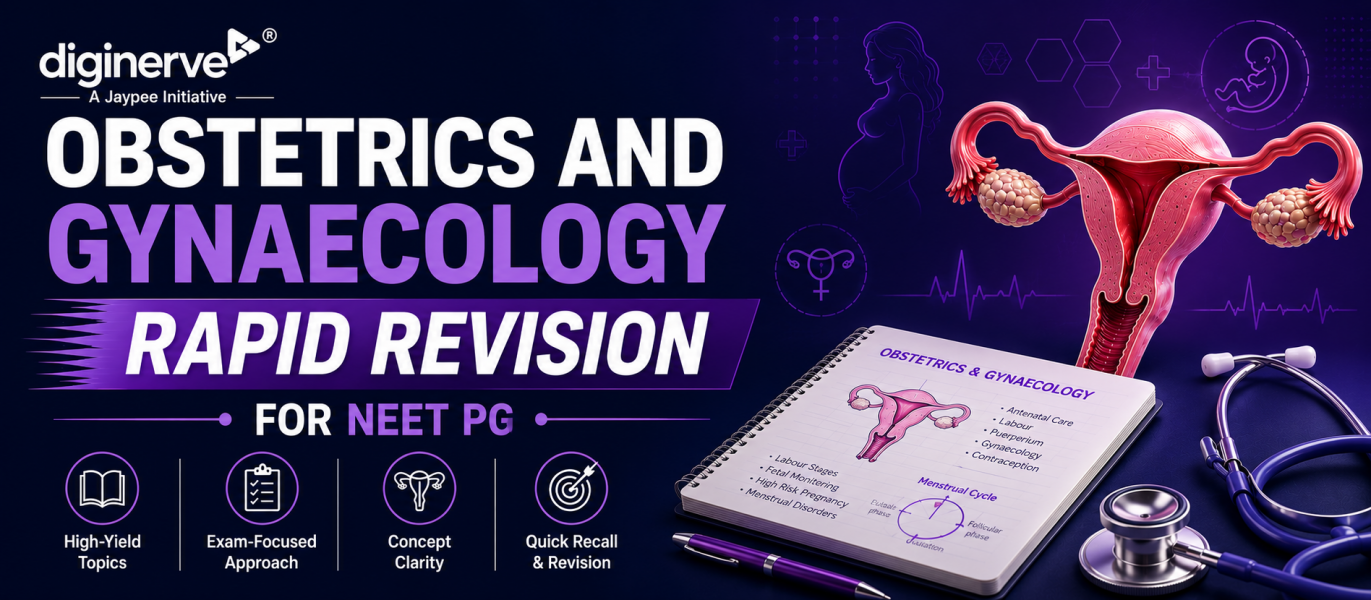
Obstetrics and Gynaecology Rapid Revision for NEET PG 2026: High-Yield Notes
Preparing Obstetrics and Gynaecology for NEET PG 2026 requires a clinical, table-based, and image-oriented revision strategy. OBGYN is one of the most important subjects because questions are commonly asked about pregnancy care, labour, obstetric emergencies, contraception, infertility, gynaecological cancers, menstrual disorders, and reproductive medicine.
OBGYN questions in NEET PG are usually case-based, diagnosis-oriented, emergency-focused, and management-based. Instead of reading lengthy theory repeatedly, aspirants should focus on high-yield topics, must-remember tables, obstetric algorithms, PYQs, image-based questions, and rapid revision notes.

Important Topics Weightage in OBGYN for NEET PG
OBGYN in NEET PG generally includes questions from obstetrics, gynaecology, reproductive medicine, contraception, infertility, oncology, menstrual disorders, obstetric emergencies, and imaging. Certain areas are repeatedly tested and should be prioritised during rapid revision.
| OBGYN Section | Importance of NEET PG |
| Antenatal Care | Very High |
| Normal Labor and Partograph | Very High |
| Obstetric Emergencies | Very High |
| Hypertensive Disorders of Pregnancy | Very High |
| Antepartum and Postpartum Haemorrhage | Very High |
| Contraception | Very High |
| Infertility | High |
| Menstrual Disorders | High |
| Gynecological Oncology | Very High |
| Reproductive Endocrinology | High |
| Instruments and Procedures | High |
| Image-Based OBGYN Questions | Very High |
High-Yield OBGYN Topics for NEET PG 2026
During the final phase of NEET PG preparation, it is important first to revise the highest-scoring OBGYN topics. These topics are commonly asked through clinical cases, emergency scenarios, ultrasound images, instruments, and management-based MCQs.
-
Antenatal Care
Antenatal care is one of the most important sections in Obstetrics for NEET PG. Focus on:
- Diagnosis of pregnancy
- Physiological changes in pregnancy
- Antenatal visits
- Screening tests in pregnancy
- High-risk pregnancy
- Iron and folic acid supplementation
- Tetanus and adult diphtheria immunisation
- Gestational diabetes mellitus
- Rh incompatibility
- Multiple pregnancy
- Fetal growth restriction
- Oligohydramnios
- Polyhydramnios
- Non-stress test
- Biophysical profile
- Doppler studies
- Expected date of delivery
-
Normal Labour and Partograph
Labour is a very high-yield area because questions are often based on stages, mechanisms, complications, and monitoring. Important topics include:
- Stages of labor
- Mechanism of labor
- Partograph
- Cervical dilatation
- Fetal station
- Engagement
- Cardinal movements
- Active management of the third stage of labour
- Induction of labor
- Augmentation of labor
- Prolonged labor
- Obstructed labor
- Trial of labor
- Episiotomy
- Normal vaginal delivery
- Instrumental delivery
-
Obstetric Emergencies
Obstetric emergencies are frequently asked because they test rapid diagnosis and management. Revise:
- Eclampsia
- Postpartum hemorrhage
- Shoulder dystocia
- Uterine rupture
- Cord prolapse
- Obstetric shock
- Amniotic fluid embolism
- Sepsis in pregnancy
- Ectopic pregnancy rupture
- Abruptio placentae
- Placenta previa bleeding
- Retained placenta
- Inversion of the uterus
- Disseminated intravascular coagulation
- Maternal collapse
-
Hypertensive Disorders of Pregnancy
Hypertensive disorders are among the most repeated OBGYN topics in NEET PG. Focus on:
- Gestational hypertension
- Preeclampsia
- Severe preeclampsia
- Eclampsia
- Chronic hypertension in pregnancy
- HELLP syndrome
- Magnesium sulfate regimen
- Antihypertensives in pregnancy
- Complications of preeclampsia
- Fetal monitoring
- Timing of delivery
- Prevention of preeclampsia
-
Antepartum Haemorrhage and Postpartum Haemorrhage
APH and PPH are high-yield because they are commonly tested as emergency clinical scenarios. Important topics include:
- Placenta previa
- Abruptio placentae
- Vasa previa
- Classification of placenta previa
- Risk factors for APH
- Clinical differentiation of placenta previa and abruption
- Primary PPH
- Secondary PPH
- Uterine atony
- Trauma-related PPH
- Retained placenta
- Coagulation failure
- Active management of the third stage of labour
- Uterotonics
- Balloon tamponade
- Surgical management of PPH
-
Medical Disorders in Pregnancy
Medical disorders in pregnancy are commonly integrated with Medicine and Pediatrics. Revise:
- Anaemia in pregnancy
- Gestational diabetes mellitus
- Thyroid disorders in pregnancy
- Heart disease in pregnancy
- Epilepsy in pregnancy
- Jaundice in pregnancy
- UTI in pregnancy
- Malaria in pregnancy
- HIV in pregnancy
- Tuberculosis in pregnancy
- Rh isoimmunization
- Antiphospholipid syndrome
- SLE in pregnancy
- Drug safety in pregnancy
-
Contraception
Contraception is one of the most scoring areas in Gynaecology. Focus on:
- Barrier methods
- Combined oral contraceptive pills
- Progesterone-only pills
- Emergency contraception
- IUCD
- Copper-T
- LNG-IUS
- Injectable contraceptives
- Implants
- Lactational amenorrhea method
- Sterilization
- Pomeroy technique
- Medical eligibility criteria
- Contraceptive failure rates
- Non-contraceptive benefits of OCPs
-
Menstrual Disorders and Reproductive Endocrinology
Menstrual disorders are frequently asked about through clinical cases and hormone-based questions. Revise:
- Amenorrhea
- Primary amenorrhea
- Secondary amenorrhea
- Abnormal uterine bleeding
- Dysmenorrhea
- Premenstrual syndrome
- PCOS
- Hyperprolactinemia
- Menopause
- Premature ovarian insufficiency
- Endometriosis
- Adenomyosis
- Fibroid uterus
- Hormonal evaluation
- HPO axis
-
Infertility
Infertility is high-yield because questions are often based on investigations and causes. Focus on:
- Primary infertility
- Secondary infertility
- Male factor infertility
- Ovulatory dysfunction
- Tubal factor infertility
- Endometriosis-related infertility
- Semen analysis
- Ovulation testing
- Hysterosalpingography
- Laparoscopy
- Assisted reproductive technology
- IUI
- IVF
- ICSI
- Ovarian stimulation
- Ovarian hyperstimulation syndrome
-
Gynaecological Oncology
Gynaecological oncology is one of the most important sections for NEET PG. Revise:
- Cervical cancer
- HPV infection
- Pap smear
- VIA/VILI
- Colposcopy
- CIN
- Cervical cancer staging basics
- Endometrial carcinoma
- Ovarian tumors
- Germ cell tumors
- Epithelial ovarian tumors
- Sex cord-stromal tumors
- Vulvar cancer
- Gestational trophoblastic disease
- Hydatidiform mole
- Choriocarcinoma
- Tumor markers
-
OBGYN Instruments and Procedures
Instruments and procedures are commonly asked in image-based questions. Focus on:
- Cusco speculum
- Sim’s speculum
- Vulsellum
- Sponge holding forceps
- Ovum forceps
- Uterine sound
- Hegar dilatators
- MVA cannula
- D&C instruments
- Ayre spatula
- Cytobrush
- Vacuum extractor
- Obstetric forceps
- IUCD insertion instruments
- Colposcope
- Laparoscope
- Hysteroscope
Must-Remember Tables for OBGYN Rapid Revision
Tables are extremely useful for last-minute OBGYN revision because they help compare obstetric emergencies, contraceptives, gynaecological cancers, tumour markers, and pregnancy complications quickly.
Placenta Previa vs Abruptio Placentae
| Feature | Placenta Previa | Abruptio Placentae |
| Bleeding | Painless | Painful |
| Blood color | Bright red | Dark red |
| Uterus | Soft, relaxed | Tender, tense |
| Fetal distress | Less common initially | Common |
| Malpresentation | Common | Less common |
| Shock | Proportionate to visible blood loss | Maybe disproportionate |
| Vaginal examination | Avoid digital examination | May be done carefully when indicated |
Causes of Postpartum Haemorrhage: 4 Ts
| Cause | Meaning |
| Tone | Uterine atony |
| Trauma | Genital tract injury |
| Tissue | Retained placenta/products |
| Thrombin | Coagulation disorder |
Hypertensive Disorders of Pregnancy
| Condition | Key Feature |
| Gestational hypertension | Hypertension after 20 weeks without proteinuria or severe features |
| Preeclampsia | Hypertension after 20 weeks with proteinuria or end-organ involvement |
| Severe preeclampsia | Severe BP or end-organ dysfunction |
| Eclampsia | Seizures in a woman with preeclampsia |
| HELLP syndrome | Hemolysis, elevated liver enzymes, and low platelets |
| Chronic hypertension | Hypertension before pregnancy or before 20 weeks |
Contraceptive Methods
| Method | Key Point |
| Condom | Barrier method, STI protection |
| Combined OCP | Estrogen + progesterone |
| Progesterone-only pill | Useful when estrogen is contraindicated |
| Copper IUCD | Long-acting reversible contraception |
| LNG-IUS | Reduces menstrual bleeding |
| Emergency contraception | Used after unprotected intercourse |
| Injectable contraception | Long-acting hormonal method |
| Tubal ligation | Permanent female sterilisation |
| Vasectomy | Permanent male sterilisation |
Gynaecological Tumour Markers
| Tumor Marker | Associated Condition |
| CA-125 | Epithelial ovarian tumor |
| Beta-hCG | Choriocarcinoma, germ cell tumors |
| AFP | Yolk sac tumour |
| LDH | Dysgerminoma |
| Inhibin | Granulosa cell tumor |
| CEA | Mucinous ovarian tumor |
| HE4 | Epithelial ovarian cancer evaluation |
Image-Based Questions in OBGYN for NEET PG 2026
Image-based OBGYN questions are common in NEET PG. Students should revise ultrasound images, instruments, cervical screening images, gynaecological tumours, obstetric emergencies, and operative procedures regularly.
Important image-based areas include:
- Ultrasound in ectopic pregnancy
- Ultrasound in molar pregnancy
- Ultrasound in multiple pregnancy
- Placenta previa ultrasound
- Fetal growth restriction Doppler
- CTG tracing
- Partograph
- Pap smear images
- Colposcopy images
- Cervical erosion
- Cervical cancer
- Ovarian tumor gross images
- Fibroid uterus
- Endometriotic cyst
- Hydatidiform mole
- OBGYN instruments
- IUCD image
- Vacuum extractor
- Obstetric forceps
- Episiotomy
- Perineal tears
- Breastfeeding position images
Previous Year Questions Trend in OBGYN
Previous year questions show that NEET PG often tests OBGYN through clinical scenarios, obstetric emergencies, contraception, oncology, instruments, and image-based diagnosis. The trend is moving toward applied obstetrics, emergency management, and decision-making questions.
Common PYQ trends include:
- Antenatal care
- Physiological changes in pregnancy
- Gestational diabetes mellitus
- Rh incompatibility
- Preeclampsia
- Eclampsia
- Magnesium sulfate regimen
- Placenta previa
- Abruptio placentae
- Postpartum hemorrhage
- Active management of the third stage of labour
- Partograph
- Labor abnormalities
- Ectopic pregnancy
- Molar pregnancy
- Contraception
- IUCD
- PCOS
- Endometriosis
- Fibroid uterus
- Infertility workup
- Cervical cancer screening
- Ovarian tumors
- Tumor markers
- OBGYN instruments
Important MCQs in OBGYN
Q1. Which drug is used as the first-line anticonvulsant in eclampsia?
A. Diazepam
B. Phenytoin
C. Magnesium sulfate
D. Lorazepam
Answer: C. Magnesium sulfate
Magnesium sulfate is the drug of choice for the prevention and treatment of seizures in eclampsia.
Q2. The most common cause of postpartum haemorrhage is:
A. Retained placenta
B. Uterine atony
C. Cervical tear
D. Coagulation disorder
Answer: B. Uterine atony
Uterine atony is the most common cause of postpartum haemorrhage and is included under “Tone” in the 4 Ts of PPH.
Q3. Which tumour marker is associated with epithelial ovarian cancer?
A. AFP
B. LDH
C. CA-125
D. Inhibin
Answer: C. CA-125
CA-125 is commonly associated with epithelial ovarian cancer and is used for monitoring disease response and recurrence.
Q4. Snowstorm appearance on ultrasound is classically seen in:
A. Ectopic pregnancy
B. Hydatidiform mole
C. Placenta previa
D. Fibroid uterus
Answer: B. Hydatidiform mole
Hydatidiform mole classically shows a snowstorm appearance on ultrasound due to swollen chorionic villi.
Q5. Which contraceptive method also protects against sexually transmitted infections?
A. Copper IUCD
B. Combined OCP
C. Condom
D. Injectable contraceptive
Answer: C. Condom
Condoms provide contraception and also reduce the risk of sexually transmitted infections.
Rapid Revision Notes for OBGYN
Here are some high-yield rapid revision points for NEET PG OBGYN:
- Preeclampsia occurs after 20 weeks of pregnancy.
- Eclampsia is preeclampsia with seizures.
- Magnesium sulfate is the drug of choice for eclampsia.
- Labetalol, nifedipine, and hydralazine are commonly used antihypertensives in pregnancy.
- Placenta previa causes painless, bright red bleeding.
- Abruptio placentae causes painful bleeding with a tender uterus.
- Uterine atony is the most common cause of postpartum haemorrhage.
- Causes of PPH are remembered as the 4 Ts: tone, trauma, tissue, thrombin.
- Active management of the third stage of labour reduces the risk of PPH.
- Rh-negative mothers may require anti-D immunoglobulin.
- GDM screening is an important antenatal topic.
- Ectopic pregnancy commonly presents with amenorrhea, pain, and bleeding.
- A hydatidiform mole can show a snowstorm appearance on ultrasound.
- PCOS commonly presents with irregular cycles, hyperandrogenism, and polycystic ovaries.
- Endometriosis causes dysmenorrhea, dyspareunia, and infertility.
- A fibroid uterus commonly causes heavy menstrual bleeding.
- A Pap smear is used for cervical cancer screening.
- HPV infection is strongly associated with cervical cancer.
- CA-125 is associated with epithelial ovarian cancer.
- AFP is associated with yolk sac tumour.
- LDH is associated with dysgerminoma.
- Inhibin is associated with granulosa cell tumours.
- A condom protects against STIs.
- Copper IUCD is a long-acting reversible contraceptive.
- Emergency contraception is used after unprotected intercourse.
- Semen analysis is an important initial test in infertility evaluation.
- HSG is used to assess tubal patency.
- A partograph is used to monitor the progress of labour.
- Shoulder dystocia is an obstetric emergency.
- Cord prolapse requires urgent management.
- Vacuum and forceps are used for instrumental delivery.
Last-Minute Tips to Revise OBGYN for NEET PG 2026
OBGYN revision should be clinical, algorithm-based, and table-oriented. In the last few weeks before NEET PG, avoid reading lengthy theory and focus on obstetric emergencies, gynaecological cancers, contraception, instruments, PYQs, and image-based questions.
- Revise obstetric emergencies daily
Preeclampsia, eclampsia, PPH, APH, shoulder dystocia, cord prolapse, ectopic pregnancy, and uterine rupture are very high yield for NEET PG.
- Focus on management algorithms
OBGYN questions often ask the next best step. Revise algorithms for eclampsia, PPH, placenta previa, ectopic pregnancy, infertility, abnormal uterine bleeding, and cervical cancer screening.
- Memorise contraception tables
Contraception is highly scored. Revise IUCDs, OCPs, emergency contraception, sterilisation, contraindications, and failure rates.
- Do not skip gynaecological oncology
Cervical cancer, ovarian tumours, endometrial carcinoma, GTD, tumour markers, and screening methods are repeatedly asked.
- Practice image-based questions
Revise ultrasound images, instruments, Pap smear, colposcopy, ovarian tumours, fibroids, molar pregnancy, and CTG.
- Revise instruments and procedures
OBGYN instruments are commonly tested. Focus on speculums, forceps, vacuum extractors, IUCD instruments, D&C instruments, and Pap smear tools.
- Integrate with Medicine and Pediatrics
Pregnancy with diabetes, hypertension, anaemia, thyroid disease, infections, and fetal complications are commonly tested as integrated questions.
- Solve PYQs thoroughly
PYQs help identify repeated clinical patterns. After every PYQ, revise the diagnosis, investigation, management, and complications of that topic.
Recommended Resources for OBGYN NEET PG Preparation
To strengthen your OBGYN preparation for NEET PG 2026, use a combination of structured video lectures, QBank practice, PYQ analysis, and rapid revision resources.
You can revise OBGYN with:
- DigiNerve NEET PG Courses
- OBGYN QBank
- OBGYN Previous Year Questions
- OBGYN One Shot Revision Videos
- Subject-wise rapid revision notes
- Image-based question practice
- Obstetric emergency revision
- Related NEET PG PYQ blogs
- Previous subject revision blog
- Next subject revision blog
Frequently Asked Questions
Q1. What are the most important topics in OBGYN for NEET PG?
Ans – Antenatal care, labour, preeclampsia, eclampsia, PPH, APH, contraception, infertility, PCOS, cervical cancer, ovarian tumours, and instruments.
Q2. How to revise OBGYN quickly for NEET PG?
Ans – Revise tables, PYQs, emergency algorithms, contraception, tumour markers, instruments, ultrasound images, and case-based MCQs.
Q3. Which OBGYN topics are most repeated in NEET PG?
Ans – Preeclampsia, eclampsia, PPH, placenta previa, abruptio placentae, ectopic pregnancy, contraception, PCOS, cervical cancer, ovarian tumours, and tumour markers.
Q4. Is rapid revision enough for NEET PG preparation?
Ans – Yes, for final revision, but combine it with MCQs, PYQs, emergency management practice, and image-based revision.