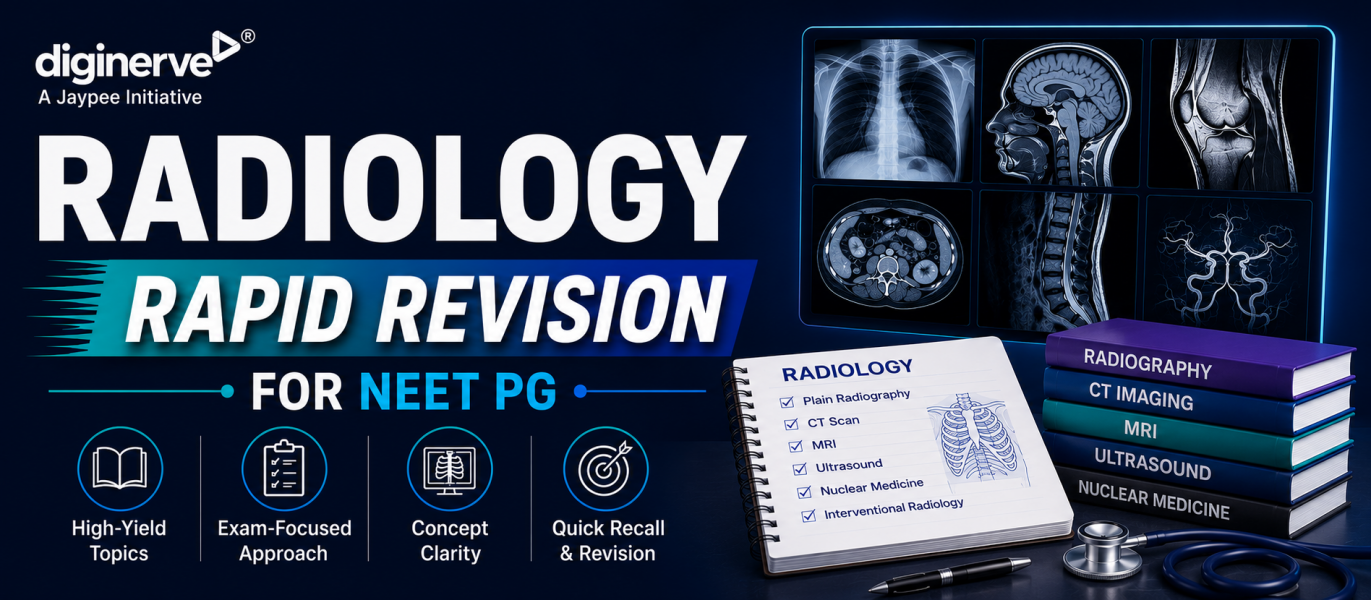
Radiology Rapid Revision for NEET PG 2026
Preparing Radiology for NEET PG 2026 requires an image-based, concept-oriented, and clinical revision strategy. Radiology is a scoring subject because many questions are based on X-rays, CT scans, MRI images, ultrasound findings, contrast studies, emergency imaging, and classic radiological signs.
Radiology questions in NEET PG are usually image-based, diagnosis-oriented, and clinically integrated. Instead of reading lengthy theory repeatedly, aspirants should focus on high-yield imaging signs, must-remember tables, common emergency radiology findings, PYQs, and rapid revision notes.

Important Topics Weightage in Radiology for NEET PG
Radiology in NEET PG generally includes questions from basic imaging, chest radiology, abdominal radiology, neuroradiology, musculoskeletal radiology, obstetric imaging, pediatric radiology, interventional radiology, and radiation safety. Certain areas are repeatedly tested and should be prioritised during rapid revision.
| Radiology Section | Importance of NEET PG |
| Chest Radiology | Very High |
| Abdominal Radiology | Very High |
| Neuroradiology | Very High |
| Musculoskeletal Radiology | High |
| Obstetric and Gynaecological Imaging | High |
| Pediatric Radiology | High |
| Emergency Radiology | Very High |
| Imaging Modalities and Basics | High |
| Contrast Studies | Moderate to High |
| Interventional Radiology | Moderate |
| Radiation Safety | High |
| Image-Based Radiology Questions | Very High |
High-Yield Radiology Topics for NEET PG 2026
During the final phase of NEET PG preparation, it is important to revise the most scoring Radiology topics first. These topics are commonly asked through images, clinical cases, X-rays, CT scans, MRI images, and ultrasound findings.
-
Basics of Imaging Modalities
The basics of imaging are important because NEET PG often tests which investigation is best for a given condition. Focus on:
- X-ray basics
- CT scan basics
- MRI basics
- Ultrasound basics
- Doppler ultrasound
- Fluoroscopy
- Mammography
- PET scan
- DEXA scan
- Contrast agents
- Radiological densities
- Hounsfield units
- MRI sequences
- T1-weighted images
- T2-weighted images
- STIR sequence
- Diffusion-weighted imaging
- Radiation exposure basics
-
Chest Radiology
Chest radiology is one of the highest-yield areas in Radiology for NEET PG. Focus on:
- Normal chest X-ray anatomy
- Pneumonia
- Pleural effusion
- Pneumothorax
- Hydropneumothorax
- Lung collapse
- Lung consolidation
- Pulmonary edema
- ARDS
- Tuberculosis
- Miliary mottling
- Lung cancer
- Mediastinal widening
- Cardiomegaly
- COPD changes
- Interstitial lung disease
- Pulmonary embolism imaging
- COVID-like viral pneumonia imaging basics
-
Abdominal Radiology
Abdominal radiology is frequently performed through X-rays, CT scans, and ultrasound images. Important topics include:
- Intestinal obstruction
- Small bowel obstruction
- Large bowel obstruction
- Volvulus
- Pneumoperitoneum
- Acute pancreatitis
- Gallstones
- Cholecystitis
- Renal stones
- Hydronephrosis
- Appendicitis imaging
- Liver abscess
- Hepatocellular carcinoma
- Ascites
- Bowel perforation
- Contrast studies
- Barium swallow
- Barium meal
- Barium enema
-
Neuroradiology
Neuroradiology is very high-yield because questions are commonly based on CT brain and MRI findings. Revise:
- CT brain anatomy
- Ischemic stroke
- Hemorrhagic stroke
- Subarachnoid hemorrhage
- Subdural hematoma
- Extradural hematoma
- Intracerebral hemorrhage
- Brain tumors
- Hydrocephalus
- Cerebral edema
- Raised intracranial pressure
- Multiple sclerosis MRI
- Meningioma
- Pituitary adenoma
- Neurocysticercosis
- Tuberculoma
- Spinal cord compression
- Disc prolapse
-
Musculoskeletal Radiology
Musculoskeletal radiology is commonly integrated with Orthopedics. Focus on:
- Fracture identification
- Dislocations
- Colles fracture
- Supracondylar fracture
- Neck of femur fracture
- Hip dislocation
- Osteomyelitis
- Septic arthritis
- Osteoarthritis
- Rheumatoid arthritis
- Ankylosing spondylitis
- Bone tumors
- Osteosarcoma
- Ewing sarcoma
- Giant cell tumor
- Multiple myeloma
- Rickets
- Osteoporosis
- Avascular necrosis
-
Obstetric and Gynaecological Imaging
OBGYN imaging is high-yield because many questions are based on ultrasound findings. Revise:
- Early pregnancy ultrasound
- Ectopic pregnancy
- Molar pregnancy
- Multiple pregnancy
- Placenta previa
- Abruptio placentae imaging basics
- Fetal growth restriction
- Doppler in pregnancy
- Amniotic fluid assessment
- Congenital anomalies
- Ovarian cyst
- Ovarian torsion
- Fibroid uterus
- Endometriotic cyst
- PCOS ultrasound
- Cervical length assessment
- Biophysical profile
-
Pediatric Radiology
Pediatric radiology questions are commonly image-based and integrated with Pediatrics and Surgery. Focus on:
- Hypertrophic pyloric stenosis
- Intussusception
- Hirschsprung disease
- Necrotizing enterocolitis
- Respiratory distress syndrome
- Meconium ileus
- Congenital diaphragmatic hernia
- Esophageal atresia
- Tracheoesophageal fistula
- Rickets
- Developmental dysplasia of hip
- Slipped capital femoral epiphysis
- Perthes disease
- Pediatric pneumonia
- Foreign body aspiration
-
Emergency Radiology
Emergency radiology is very important because NEET PG questions often ask for the diagnosis or the next best investigation. Revise:
- Head trauma CT
- Extradural hematoma
- Subdural hematoma
- Intracranial hemorrhage
- Cervical spine trauma
- Pneumothorax
- Tension pneumothorax
- Hemothorax
- Rib fracture
- Flail chest
- Pneumoperitoneum
- Bowel obstruction
- Acute appendicitis
- Acute pancreatitis
- Renal colic
- Testicular torsion Doppler
- Pulmonary embolism CT angiography
- Aortic dissection CT angiography
-
Contrast Studies
Contrast studies are frequently requested through classic signs. Focus on:
- Barium swallow
- Barium meal
- Barium follow-through
- Barium enema
- IVU
- MCU
- ERCP
- HSG
- Angiography
- CT contrast phases
- Contraindications to contrast
- Contrast-induced nephropathy
- Allergic reactions to contrast
- Water-soluble contrast use
- Classic barium signs
-
Interventional Radiology and Radiation Safety
This section is increasingly important in applied Radiology. Revise:
- FNAC and biopsy guidance
- USG-guided aspiration
- CT-guided biopsy
- Angioplasty
- Embolization
- Chemoembolization
- Radiofrequency ablation
- Nephrostomy
- Biliary drainage
- Abscess drainage
- Radiation dose
- ALARA principle
- Radiation protection
- Lead apron
- Thyroid shield
- Pregnancy and radiation
- Contrast safety
Must-Remember Tables for Radiology Rapid Revision
Tables are extremely useful for last-minute Radiology revision because they help compare imaging modalities, radiological signs, CT findings, and emergency imaging choices quickly.
Best Imaging Modality for Common Conditions
| Condition | Preferred Imaging |
| Stroke emergency | Non-contrast CT brain initially |
| Brain tumor | MRI brain |
| Head trauma | Non-contrast CT brain |
| Pulmonary embolism | CT pulmonary angiography |
| Gallstones | Ultrasound abdomen |
| Renal stones | Non-contrast CT KUB |
| Appendicitis | Ultrasound/CT abdomen, depending on the case |
| Ectopic pregnancy | Transvaginal ultrasound |
| Placenta previa | Ultrasound |
| Soft tissue injury | MRI |
| Bone fracture | X-ray |
| Intervertebral disc prolapse | MRI spine |
Radiological Densities on X-ray
| Density | Appearance |
| Air | Black |
| Fat | Dark gray |
| Soft tissue/fluid | Gray |
| Bone/calcium | White |
| Metal | Bright white |
Classic Radiological Signs
| Sign | Associated Condition |
| Air under the diaphragm | Hollow viscus perforation |
| Coffee bean sign | Sigmoid volvulus |
| Double bubble sign | Duodenal atresia |
| String sign | Crohn’s disease/hypertrophic pyloric stenosis is context-dependent |
| Bird beak sign | Achalasia cardia/sigmoid volvulus is context-dependent |
| Apple core lesion | Carcinoma colon |
| Codman triangle | Osteosarcoma |
| Sunburst appearance | Osteosarcoma |
| Onion-skin appearance | Ewing sarcoma |
| Soap-bubble appearance | Giant cell tumor |
| Bat wing appearance | Pulmonary edema |
| Hampton hump | Pulmonary embolism |
CT Findings in Intracranial Haemorrhage
| Condition | CT Finding |
| Extradural hematoma | Biconvex/lens-shaped bleed |
| Subdural hematoma | Crescent-shaped bleed |
| Subarachnoid hemorrhage | Blood in basal cisterns/sulci |
| Intracerebral hemorrhage | Hyperdense bleed within the brain parenchyma |
| Intraventricular hemorrhage | Blood within the ventricles |
MRI Sequences: Quick Revision
| MRI Sequence | Useful Feature |
| T1-weighted image | Fat bright, anatomy detail |
| T2-weighted image | Fluid bright |
| FLAIR | Suppresses CSF signal, useful in brain lesions |
| DWI | Acute infarct detection |
| STIR | Fat suppression, oedema detection |
| Contrast-enhanced MRI | Tumour, infection, and inflammation evaluation |
Image-Based Questions in Radiology for NEET PG
Image-based Radiology questions are very common in NEET PG. Students should revise X-rays, CT scans, MRI images, ultrasound findings, contrast studies, and classic signs regularly.
Important image-based areas include:
- Chest X-ray pneumonia
- Chest X-ray pleural effusion
- Chest X-ray pneumothorax
- Chest X-ray, pulmonary oedema
- Chest X-ray tuberculosis
- Air under the diaphragm
- Intestinal obstruction X-ray
- Coffee bean sign
- Double bubble sign
- CT brain extradural hematoma
- CT brain subdural hematoma
- CT brain stroke
- CT brain haemorrhage
- MRI multiple sclerosis
- MRI disc prolapse
- X-ray fractures
- Osteosarcoma X-ray
- Ewing sarcoma X-ray
- Giant cell tumor X-ray
- Ultrasound gallstones
- Ultrasound hydronephrosis
- Ultrasound ectopic pregnancy
- Molar pregnancy ultrasound
- Mammography images
- Barium swallow images
- Barium enema images
Previous Year Questions Trend in Radiology
Previous year questions show that NEET PG often tests Radiology through classic images, emergency findings, best investigation questions, and radiological signs. The trend is moving toward applied imaging and integrated clinical decision-making.
Common PYQ trends include:
- Chest X-ray interpretation
- Pleural effusion
- Pneumothorax
- Pulmonary edema
- Tuberculosis imaging
- Pneumoperitoneum
- Intestinal obstruction
- Volvulus signs
- CT brain haemorrhage
- Extradural hematoma
- Subdural hematoma
- Stroke imaging
- MRI brain lesions
- Disc prolapse MRI
- Bone tumor X-ray signs
- Fracture imaging
- Obstetric ultrasound
- Ectopic pregnancy imaging
- Molar pregnancy ultrasound
- Barium swallow signs
- Best imaging modality questions
- Radiation safety
Important MCQs in Radiology
Q1. A biconvex or lens-shaped haemorrhage on CT brain is seen in:
A. Subdural hematoma
B. Extradural hematoma
C. Subarachnoid hemorrhage
D. Intracerebral haemorrhage
Answer: B. Extradural hematoma
Extradural hematoma classically appears as a biconvex or lens-shaped hyperdense collection on CT brain.
Q2. A crescent-shaped haemorrhage on CT brain is suggestive of:
A. Extradural hematoma
B. Subdural hematoma
C. Intraventricular haemorrhage
D. Epidermoid cyst
Answer: B. Subdural hematoma
Subdural hematoma appears as a crescent-shaped collection on CT of the brain.
Q3. Air under the diaphragm on an erect X-ray abdomen suggests:
A. Intestinal obstruction
B. Acute pancreatitis
C. Hollow viscus perforation
D. Renal colic
Answer: C. Hollow viscus perforation
Air under the diaphragm on erect X-ray abdomen suggests pneumoperitoneum due to hollow viscus perforation.
Q4. Coffee bean sign is classically associated with:
A. Sigmoid volvulus
B. Acute appendicitis
C. Duodenal atresia
D. Renal stone
Answer: A. Sigmoid volvulus
A coffee bean sign on abdominal X-ray is classically associated with sigmoid volvulus.
Q5. Which imaging modality is preferred for gallstones?
A. MRI brain
B. Ultrasound abdomen
C. CT brain
D. Mammography
Answer: B. Ultrasound abdomen
Ultrasound of the abdomen is the preferred initial imaging modality for gallstones.
Rapid Revision Notes for Radiology
Here are some high-yield rapid revision points for NEET PG Radiology:
- Air appears black on X-ray.
- Bone and calcium appear white on X-ray.
- CT is commonly used in acute head trauma.
- MRI is better for soft tissue, brain, spine, and joints.
- Ultrasound is preferred for gallstones and obstetric imaging.
- Non-contrast CT of the brain is the initial imaging in suspected acute stroke.
- Extradural hematoma appears biconvex or lens-shaped on CT.
- Subdural hematoma appears crescent-shaped on CT.
- Subarachnoid haemorrhage shows blood in sulci and basal cisterns.
- Air under the diaphragm suggests a hollow viscus perforation.
- Multiple air-fluid levels suggest intestinal obstruction.
- The coffee bean sign is seen in sigmoid volvulus.
- The double bubble sign is seen in duodenal atresia.
- Apple core lesion is seen in carcinoma of the colon.
- The bird beak sign may be seen in achalasia cardia or volvulus, depending on context.
- Bat wing appearance is seen in pulmonary oedema.
- Pleural effusion shows a meniscus sign on chest X-ray.
- Pneumothorax shows absent lung markings beyond the pleural line.
- Miliary TB shows diffuse tiny nodular opacities.
- CT pulmonary angiography is used for pulmonary embolism.
- Ultrasound of the abdomen is preferred for gallstones.
- Non-contrast CT KUB is highly useful for renal stones.
- MRI spine is preferred for disc prolapse.
- DWI MRI is useful for an acute infarct.
- T2 MRI shows fluid as bright.
- Osteosarcoma shows a sunburst appearance and a Codman triangle.
- Ewing sarcoma shows an onion-skin appearance.
- Giant cell tumour shows a soap-bubble appearance.
- Mammography is used for breast screening and evaluation.
- ALARA means radiation exposure should be as low as reasonably achievable.
Last-Minute Tips to Revise Radiology for NEET PG 2026
Radiology revision should be image-based, sign-oriented, and clinically integrated. In the last few weeks before NEET PG, avoid reading lengthy theory and focus on high-yield images, classic signs, best investigations, emergency imaging, and PYQs.
-
Revise classic images daily
Radiology is highly image-based. Revise chest X-rays, CT brain, abdominal X-rays, bone tumour X-rays, ultrasound images, and MRI findings daily.
-
Focus on emergency radiology
Emergency imaging is repeatedly asked. Revise extradural hematoma, subdural hematoma, pneumothorax, pneumoperitoneum, intestinal obstruction, renal colic, stroke, and pulmonary embolism.
-
Memorise the best investigation tables
Many questions ask about the best initial or preferred imaging modality. Make a quick table for stroke, trauma, gallstones, renal stones, pregnancy, PE, appendicitis, and disc prolapse.
-
Learn radiological signs with conditions
Classic signs are high-yield. Revise coffee bean sign, double bubble sign, apple core lesion, sunburst appearance, onion-skin appearance, soap-bubble appearance, and bat wing appearance.
-
Practice CT brain interpretation
CT brain findings are common in NEET PG. Revise extradural, subdural, subarachnoid, intracerebral haemorrhage, infarct, oedema, and hydrocephalus.
-
Revise the chest X-ray systematically
Practice reading trachea, lungs, pleura, heart size, mediastinum, diaphragm, bones, and soft tissues in every chest X-ray.
-
Do not skip radiation safety
Radiation protection, pregnancy precautions, contrast safety, and the ALARA principle are commonly asked as direct questions.
-
Solve PYQs thoroughly
PYQs help identify repeated radiological signs and image patterns. After every PYQ, revise the modality, diagnosis, radiological sign, and next best investigation.
Recommended Resources for Radiology NEET PG Preparation
To strengthen your Radiology preparation for NEET PG 2026, use a combination of structured video lectures, image-based QBank practice, PYQ analysis, and rapid revision resources.
You can revise Radiology with:
- DigiNerve NEET PG Courses
- Radiology QBank
- Radiology Previous Year Questions
- Radiology One-Shot Revision Videos
- Subject-wise rapid revision notes
- Image-based question practice
- X-ray, CT, MRI and ultrasound revision
- Related NEET PG PYQ blogs
- Previous subject revision blog
Frequently Asked Questions
Q1. What are the most important topics in Radiology for NEET PG?
Ans – Chest X-rays, CT brain, abdominal X-rays, ultrasound, MRI basics, emergency radiology, bone tumour signs, obstetric imaging, and best investigation questions.
Q2. How to revise Radiology quickly for NEET PG?
Ans – Revise classic images, radiological signs, best imaging modality tables, PYQs, emergency CT/X-ray findings, and image-based MCQs.
Q3. Which Radiology topics are most repeated in NEET PG?
Ans – Extradural hematoma, subdural hematoma, pneumothorax, pleural effusion, pneumoperitoneum, intestinal obstruction, volvulus signs, gallstones, renal stones, and bone tumour X-ray signs.
Q4. Is rapid revision enough for NEET PG preparation?
Ans – Yes, for final revision, but combine it with MCQs, PYQs, image-based practice, and repeated review of classic radiological signs.