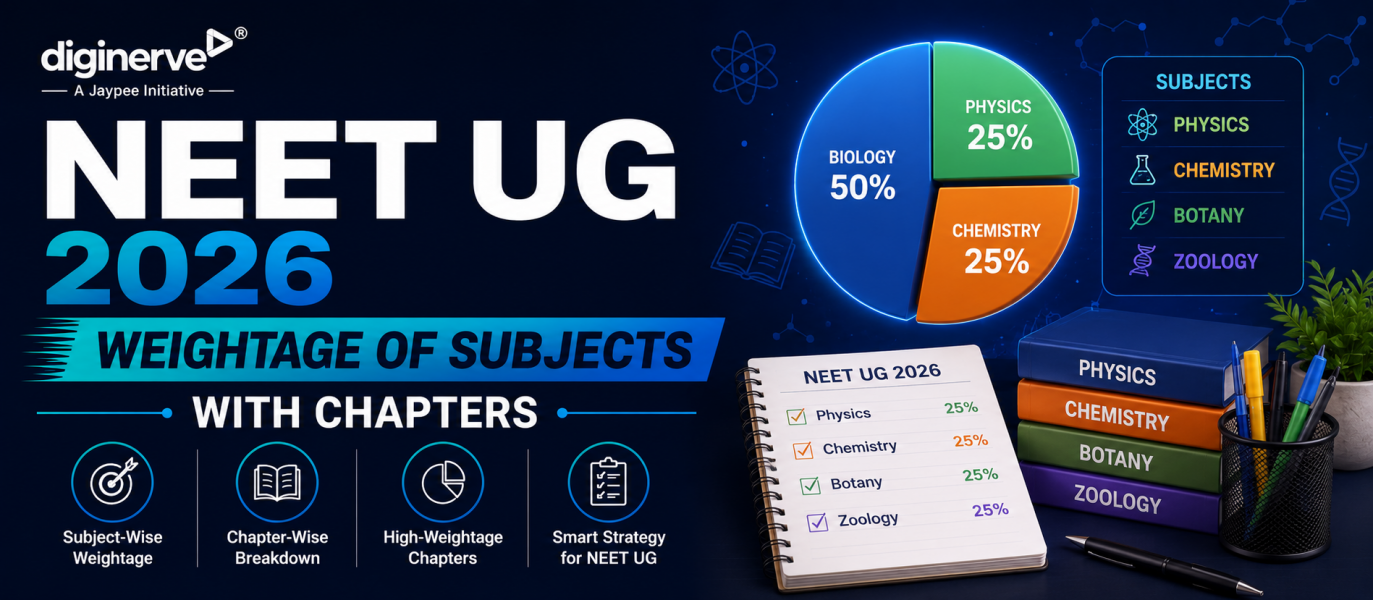
NEET UG 2026 Weightage of Subjects with Chapters
NEET UG is one of the most competitive entrance examinations in India for students who want admission to MBBS, BDS, AYUSH, and other undergraduate medical courses. Every year, lakhs of students appear for NEET UG, making smart preparation extremely important.
To score well in NEET UG 2026, students must understand the syllabus, exam pattern, subject-wise marks distribution, and chapter-wise weightage. Weightage helps students identify which chapters usually contribute more questions in the exam. However, students should remember that weightage is based on previous year trends and may vary in the actual exam.
The National Medical Commission has released the NEET UG 2026 syllabus, and students are advised to follow the official syllabus strictly while preparing. NEET UG is conducted by the National Testing Agency as a common entrance test for admission to undergraduate medical education in India. The exam includes Physics, Chemistry, and Biology, with Biology carrying the highest marks.
This blog provides the NEET UG 2026 chapter-wise weightage for Physics, Chemistry, Botany and Zoology, along with a preparation strategy to help students plan their study schedule effectively.
NEET UG 2026 Exam Pattern
Before checking chapter-wise weightage, students should understand the exam pattern.
| Particular | Details |
| Exam Name | NEET UG 2026 |
| Conducting Body | National Testing Agency |
| Mode of Exam | Offline / Pen-and-paper mode |
| Subjects | Physics, Chemistry, Biology |
| Biology Sections | Botany and Zoology |
| Total Marks | 720 |
| Physics Marks | 180 |
| Chemistry Marks | 180 |
| Biology Marks | 360 |
| Question Type | Multiple Choice Questions |
| Marking Scheme | +4 for correct answer, -1 for incorrect answer |
Since Biology carries 360 marks, it has the highest weightage in NEET UG. However, Physics and Chemistry are also rank-deciding subjects because many students score similarly in Biology. A balanced preparation strategy is important to achieve a high NEET score.
NEET UG 2026 Chapter-Wise Weightage for Biology
Biology is the most important subject in NEET UG because it carries 50% of the total marks. The Biology section includes Botany and Zoology. Students should focus on NCERT concepts, diagrams, examples, tables, and previous year questions.
High-scoring areas in Biology usually include Genetics, Human Physiology, Ecology, Biotechnology, Reproduction, Plant Physiology, and Diversity in Living Organisms.
NEET UG 2026 Chapter-Wise Weightage for Botany
Botany includes topics from plant biology, genetics, ecology, cell biology, reproduction, and plant physiology. Many questions are directly based on NCERT lines, diagrams, and examples. Students should revise the NCERT thoroughly and practice assertion-reason and statement-based questions.
| Botany Chapter | Average Questions | Approx. Weightage |
| Molecular Basis of Inheritance | 6 | 14% |
| Principles of Inheritance and Variation | 5 | 10% |
| Cell Cycle and Cell Division | 4 | 9% |
| Anatomy of Flowering Plants | 3 | 7% |
| Plant Kingdom | 3 | 7% |
| Sexual Reproduction in Flowering Plants | 3 | 6% |
| Morphology of Flowering Plants | 3 | 6% |
| Plant Growth and Development | 3 | 6% |
| Cell: The Unit of Life | 2 | 5% |
| Respiration in Plants | 2 | 5% |
| Biodiversity and Conservation | 2 | 4% |
| Microbes in Human Welfare | 2 | 4% |
| Ecosystem | 2 | 4% |
| Organisms and Populations | 2 | 4% |
| Photosynthesis in Higher Plants | 2 | 4% |
| Biological Classification | 1 | 3% |
| The Living World | 0–1 | 1% |
High-priority Botany chapters: Molecular Basis of Inheritance, Principles of Inheritance and Variation, Cell Cycle and Cell Division, Plant Kingdom, Anatomy of Flowering Plants, and Sexual Reproduction in Flowering Plants.
NEET UG 2026 Chapter-Wise Weightage for Zoology
Zoology includes human physiology, animal diversity, reproduction, biotechnology, evolution, and health-related topics. This section is highly scoring when students revise NCERT facts, flowcharts, examples, and diagrams regularly.
| Zoology Chapter | Average Questions | Approx. Weightage |
| Animal Kingdom | 7 | 13% |
| Biotechnology: Principles and Processes | 6 | 12% |
| Biomolecules | 5 | 10% |
| Structural Organisation in Animals | 4 | 8% |
| Reproductive Health | 4 | 8% |
| Biotechnology and its Applications | 4 | 7% |
| Locomotion and Movement | 3 | 6% |
| Evolution | 3 | 6% |
| Human Reproduction | 3 | 6% |
| Human Health and Disease | 3 | 6% |
| Body Fluids and Circulation | 2 | 5% |
| Excretory Products and their Elimination | 2 | 5% |
| Breathing and Exchange of Gases | 2 | 4% |
| Chemical Coordination and Integration | 2 | 4% |
| Neural Control and Coordination | 1 | 2% |
High-priority Zoology chapters: Animal Kingdom, Biotechnology, Biomolecules, Reproductive Health, Human Reproduction, Human Health and Disease, and Human Physiology chapters.
NEET UG 2026 Chapter-Wise Weightage for Chemistry
Chemistry in NEET UG includes Physical Chemistry, Organic Chemistry, and Inorganic Chemistry. Students should not depend only on memorisation. Physical Chemistry needs formula-based practice, Organic Chemistry requires concept clarity and reaction understanding, while Inorganic Chemistry needs repeated NCERT revision.
| Chemistry Chapter | Average Questions | Approx. Weightage |
| Aldehydes, Ketones and Carboxylic Acids | 3 | 9% |
| Hydrocarbons | 3 | 7% |
| Chemical Bonding and Molecular Structure | 3 | 7% |
| Equilibrium | 2 | 6% |
| The p-Block Elements | 2 | 6% |
| The d and f-Block Elements | 2 | 6% |
| Organic Chemistry: Some Basic Principles and Techniques | 2 | 5% |
| Thermodynamics | 2 | 5% |
| Electrochemistry | 2 | 5% |
| Chemical Kinetics | 2 | 5% |
| Coordination Compounds | 2 | 5% |
| Amines | 2 | 5% |
| Structure of Atom | 2 | 4% |
| Biomolecules | 2 | 4% |
| Some Basic Concepts of Chemistry | 2 | 4% |
| Alcohols, Phenols and Ethers | 1 | 4% |
| Haloalkanes and Haloarenes | 1 | 4% |
| Solutions | 1 | 4% |
| Redox Reactions | 1 | 3% |
| Classification of Elements and Periodicity | 1 | 2% |
High-priority Chemistry chapters: Chemical Bonding, Coordination Compounds, Hydrocarbons, Aldehydes, Ketones and Carboxylic Acids, Thermodynamics, Electrochemistry, Equilibrium, and Organic Chemistry basics.
Chemistry Preparation Strategy
For Chemistry, divide your preparation into three parts:
Physical Chemistry: Focus on formulas, numerical practice, units, graphs, and repeated revision. Chapters like Thermodynamics, Electrochemistry, Equilibrium, Chemical Kinetics, and Mole Concept need regular problem-solving.
Organic Chemistry: Understand GOC, reaction mechanisms, name reactions, conversions, and NCERT examples. Do not learn reactions in isolation; connect them chapter-wise.
Inorganic Chemistry: Read NCERT line by line, especially Chemical Bonding, Coordination Compounds, p-Block, d and f-Block, and Periodic Table. Make short notes for exceptions, colours, trends, and important compounds.
NEET UG 2026 Chapter-Wise Weightage for Physics
Physics is often considered the most challenging subject in NEET UG because it requires conceptual clarity, formula application, and numerical practice. Instead of memorising formulas only, students should understand concepts and practice previous year questions.
| Physics Chapter | Average Questions | Approx. Weightage |
| Current Electricity | 5 | 10% |
| Rotational Motion | 3 | 6% |
| Ray Optics and Optical Instruments | 3 | 6% |
| Electrostatic Potential and Capacitance | 3 | 5% |
| Semiconductor Electronics | 3 | 5% |
| Units and Measurements | 3 | 5% |
| Moving Charges and Magnetism | 2 | 5% |
| Nuclei | 2 | 4% |
| Alternating Current | 2 | 4% |
| Mechanical Properties of Fluids | 2 | 3% |
| Electromagnetic Waves | 2 | 3% |
| Dual Nature of Radiation and Matter | 2 | 3% |
| Gravitation | 2 | 3% |
| Work, Energy and Power | 2 | 3% |
| Electric Charges and Fields | 2 | 3% |
| Motion in a Straight Line | 1 | 3% |
| Motion in a Plane | 1 | 3% |
| Kinetic Theory of Gases | 1 | 3% |
| Atoms | 1 | 3% |
| Laws of Motion | 1 | 2% |
| Thermodynamics | 1 | 2% |
| Wave Optics | 1 | 2% |
| Waves | 1 | 1% |
| Magnetism and Matter | 1 | 1% |
| Mathematical Tools and Vectors | 1 | 1% |
High-priority Physics chapters: Current Electricity, Ray Optics, Rotational Motion, Electrostatics, Magnetism, Semiconductor Electronics, Modern Physics, Units and Measurements, and Work Energy Power.
Physics Preparation Strategy
Physics preparation should be based on concept clarity and daily practice. Students should first learn formulas and derivations, then solve NCERT examples, previous year questions, and mock test problems.
To improve Physics scores:
- Maintain a formula notebook.
- Practice 20–30 numerical questions daily.
- Revise units and dimensions regularly.
- Analyse mistakes after every mock test.
- Focus on high-yield chapters first, but do not skip low-weightage chapters completely.
- Practice mixed-topic questions to improve speed and accuracy.
Subject-Wise Preparation Priority for NEET UG 2026
| Priority Level | Subjects/Chapters |
| Very High Priority | Genetics, Biotechnology, Human Physiology, Current Electricity, Chemical Bonding, Organic Chemistry |
| High Priority | Ecology, Plant Physiology, Ray Optics, Electrochemistry, Coordination Compounds |
| Moderate Priority | Diversity, Reproduction, Thermodynamics, Modern Physics, Equilibrium |
| Revision Priority | NCERT examples, diagrams, tables, formulas, PYQs, mock test mistakes |
How to Use Chapter-Wise Weightage Correctly
Chapter-wise weightage should be used as a planning tool, not as a shortcut. Students should not skip any chapter completely because NEET questions can come from any part of the official syllabus.
Use weightage in this way:
- Start with high-weightage chapters.
- Complete NCERT reading for Biology and Inorganic Chemistry.
- Practice numerical questions daily for Physics and Physical Chemistry.
- Revise weak chapters every week.
- Solve the previous year’s questions after completing each chapter.
- Take full-length mock tests regularly.
- Analyse wrong answers and update your revision notes.
90-Day NEET UG 2026 Revision Plan
| Time Period | Preparation Focus |
| Days 1–30 | Complete high-weightage chapters and revise the NCERT Biology |
| Days 31–60 | Practice PYQs, strengthen weak chapters, and revise formulas |
| Days 61–75 | Attempt full-length mock tests and analyse mistakes |
| Days 76–90 | Final revision, diagrams, NCERT tables, formulas, and error notebook |
During the last 90 days, students should avoid starting too many new resources. Focus on NCERT, previous year questions, mock tests, and revision notes.
Common Mistakes Students Should Avoid
Many NEET aspirants work hard but lose marks due to avoidable mistakes. Avoid these common errors:
- Ignoring NCERT Biology
- Skipping Physics numericals
- Memorising Organic Chemistry without understanding concepts
- Not revising Inorganic Chemistry regularly
- Taking mock tests without analysing mistakes
- Studying only high-weightage chapters
- Using too many books and resources
- Not maintaining a formula and error notebook
- Ignoring negative marking
- Leaving revision for the last month
DigiNerve for NEET UG Preparation
A smart NEET UG preparation strategy requires strong concepts, regular practice, revision, and exam-focused learning. DigiNerve helps medical aspirants prepare with structured learning resources, chapter-wise study material, expert-led video lectures, quizzes, and practice tools.
DigiOne and DigiNEET can support students by helping them build subject understanding, revise important topics, practice MCQs, and stay consistent with their preparation. With the right guidance, students can use chapter-wise weightage and mock test analysis to improve their score effectively.
Conclusion
NEET UG 2026 chapter-wise weightage helps students understand which chapters have been more important in previous years. Biology carries the highest marks, while Physics and Chemistry play a major role in improving rank and overall score.
Students should use weightage to prioritise their preparation, but they should not depend on it completely. The best strategy is to follow the official NEET UG syllabus, study NCERT thoroughly, solve previous year questions, take regular mock tests, and revise consistently.
A balanced approach across Physics, Chemistry, Botany, and Zoology can help students improve accuracy, speed, confidence, and final NEET UG performance.
Frequently Asked Questions:
Q1. Which subject has the highest weightage in NEET UG?
Ans – Biology has the highest weightage in NEET UG. It carries 360 marks out of 720, while Physics and Chemistry carry 180 marks each.
Q2. Is NCERT enough for NEET UG Biology?
Ans – NCERT is the most important source for NEET UG Biology. Students should read NCERT line by line and revise diagrams, examples, tables, and summary points.
Q3. Which Physics chapters are most important for NEET UG?
Ans – Current Electricity, Ray Optics, Rotational Motion, Electrostatics, Magnetism, Semiconductor Electronics, Modern Physics, and Units and Measurements are important chapters.
Q4. Which Chemistry chapters have high weightage in NEET UG?
Ans – Chemical Bonding, Coordination Compounds, Hydrocarbons, Aldehydes Ketones and Carboxylic Acids, Thermodynamics, Electrochemistry, Equilibrium, and Organic Chemistry basics are important.
Q5. Should I study only high-weightage chapters for NEET UG?
Ans – No. Weightage should be used for prioritisation, not for skipping chapters. Students should complete the official syllabus and revise high-weightage chapters more frequently.
Q6. How many marks does Biology carry in NEET UG?
Ans – Biology carries 360 marks in NEET UG. It includes Botany and Zoology.
Q7. How should I revise NEET UG in the last 90 days?
Ans – In the last 90 days, focus on NCERT revision, previous year questions, mock tests, formula revision, diagrams, tables, and mistake analysis.