Male vs Female Pelvis: Key Anatomical Differences, Joints & Structure Explained
The human pelvis is a remarkable structure, essential for supporting the upper body, facilitating movement and protecting vital organs. However, the pelvic anatomy in males and females shows distinct differences that are primarily linked to their unique biological functions, particularly childbirth in females.
This blog post will delve into these intriguing anatomical variations, exploring the structural distinctions, the role of pelvic joints and their overall impact.
What Is the Pelvis?
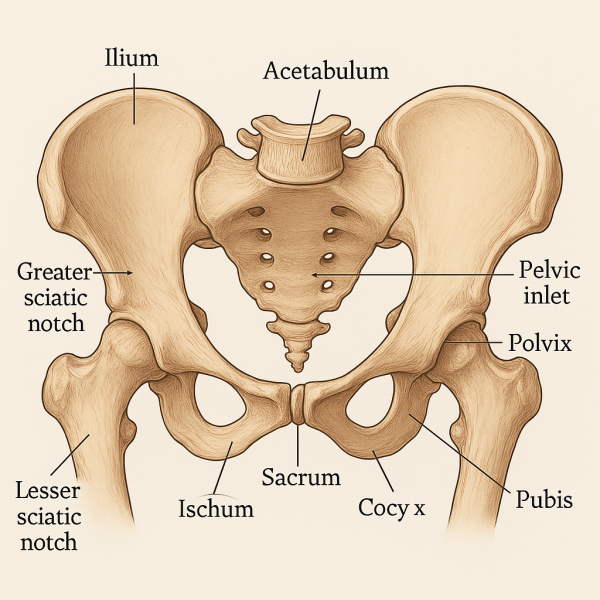
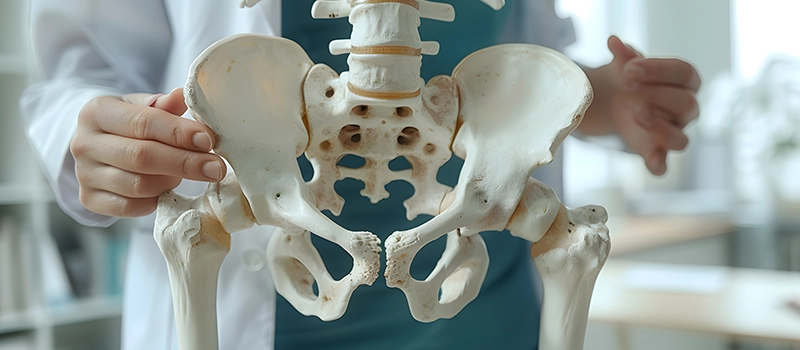
The pelvis is the bony ring located at the base of the spine formed by the fusion of several bones, the sacrum, coccyx and two hip bones (each comprised of the ilium, ischium and pubis). It acts as a bridge, connecting the axial skeleton (the spine) to the appendicular skeleton (the lower limbs). Understanding the anatomy of the pelvis is important in fields such as medicine, physical therapy, and even forensics.
Male Pelvis Anatomy
The male pelvis is designed for strength and stability, reflecting its primary role in supporting a heavier upper body and facilitating efficient bipedal locomotion.
Key features of the male pelvis include:
- Thicker and heavier bones provide greater support and stability.
- Heart-shaped pelvic inlet: A narrower inlet enhances stability during weight-bearing activities.
- Acute pubic arch: Typically, less than 90 degrees.
- Longer and more curved sacrum: Angles inwards and relatively immobile.
Female Pelvis Anatomy
The female pelvis is adapted to the demands of pregnancy and childbirth
Key features of the female pelvic anatomy include:
- Lighter, thinner and more delicate bones
- Wider and broader structure
- Rounded and oval-shaped pelvic inlet
- Wider pubic arch: Typically, greater than 90 degrees
- Shorter and less curved sacrum
- More mobile coccyx
Male vs Female Pelvis – Key Differences
A comparison of the key anatomical distinctions between the female and male pelvis:
| Feature | Female Pelvis | Male Pelvis |
| General Structure | Broad, shallow, and more circular | Narrow, deep, and more heart-shaped |
| Pelvic Inlet | Larger and oval-shaped | Smaller and heart-shaped |
| Pelvic Outlet | Wider to allow childbirth | Narrower |
| Subpubic Angle | Wider (80–90°) | Narrower (50–60°) |
| Sacrum | Shorter, wider, and less curved | Longer, narrower, and more curved |
| Ischial Spines | Less prominent, wider apart | More prominent, closer together |
| Greater Sciatic Notch | Wider | Narrower |
| Overall Bone Thickness | Lighter and thinner | Heavier and thicker |
| Acetabulum | Smaller and faces more anteriorly | Larger and faces more laterally |
| Function | Adapted for pregnancy and childbirth | Adapted for support and locomotion |
Joints of the Pelvis
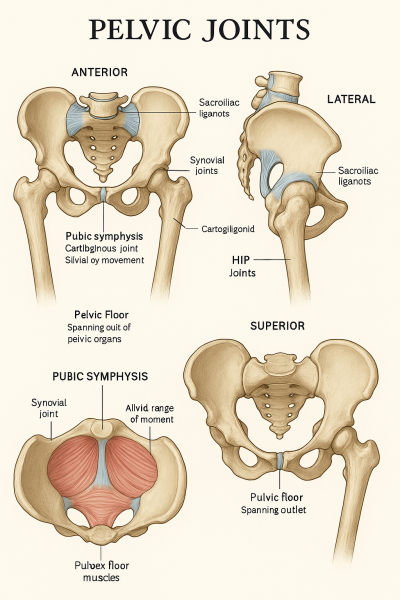
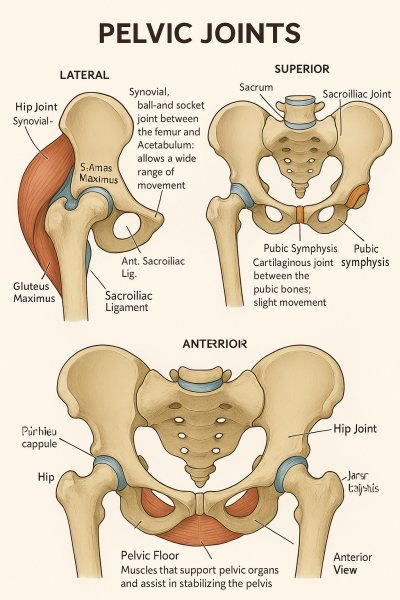
Both male and female pelvises share the same fundamental joint structures, although mobility can vary:
- Sacroiliac Joints (SI joints): Connecting the sacrum to the iliac bones, these joints are crucial for weight transmission.
- Pubic Symphysis: This cartilaginous joint joins the two pubic bones anteriorly and allows for slight movement, especially in females during childbirth.
- Sacrococcygeal Joint: A hinge joint connecting the sacrum and coccyx, it allows for limited movement with greater flexibility in females during labour.
Ligaments reinforce these joints, maintaining pelvic stability. In females, hormonal changes during pregnancy can increase ligament flexibility aiding childbirth.
Clinical & Functional Relevance
The differences in male and female pelvic anatomy have significant clinical and functional implications.
- Childbirth: The wider female pelvis is crucial for vaginal delivery.
- Biomechanics and Locomotion: The narrower male pelvis is optimised for stability during activities like walking and running, while the wider female pelvis can slightly influence gait.
- Forensic Anthropology: Pelvic bone morphology is a key factor in determining the biological sex of skeletal remains.
- Pelvic Floor Health: The Pelvic structure impacts the pelvic floor muscles, which support organs.
- Orthopaedics: Understanding pelvic anatomy is essential for diagnosing and treating conditions like hip and sacroiliac joint issues and pelvic features.
Conclusion
The male and female pelvis, while sharing a common basic structure, showcase remarkable adaptations tailored to their distinct biological roles. The female pelvis is uniquely designed for the miracle of childbirth, characterised by wider dimensions and greater flexibility. In contrast, the male pelvis prioritises stability and weight-bearing, reflecting its role in robust locomotion. Understanding these intricate anatomical differences is fundamental not only for medical
DigiNerve’s expertly designed Prof 1 MBBS Course offers comprehensive anatomy lessons, including detailed modules on the female and male pelvis, tailored to help first-year medical students grasp complex concepts with ease. With high-quality visuals, expert faculty, and exam-focused content, this course ensures you’re well-prepared for both theory and practicals. Start your journey to anatomical mastery with DigiNerve today.