Forensic Autopsy Explained: Key Types, Incisions, and Procedures
Autopsies are a cornerstone of forensic medicine, offering deep insights into the cause and manner of death. For NEET PG preparation, especially in Forensic Medicine, understanding the types of autopsies, autopsy techniques, and incisions is important. This blog simplifies these concepts making it easier for aspirants to recall them during exams.
An autopsy is a post-mortem examination of a body to determine the cause of death. It is broadly classified into various types depending on the purpose and approach. Understanding forensic autopsy, in particular, is essential for medico-legal investigations.
Types of Autopsies
- Clinical Autopsy
- Conducted in hospitals
- Purpose: Study disease progression and efficacy of treatment
- Require family consent
- Medicolegal Autopsy
- Ordered by legal authorities (police or magistrate)
- Conducted in unnatural or suspicious deaths
- No consent is required from the family
- Forensic Autopsy
- A type of medicolegal autopsy
- Involves detailed documentation for criminal investigations
- Psychological Autopsy
- A retrospective analysis of a deceased person’s mental state especially in suspected suicide cases
- Virtual Autopsy (Virtopsy)
- Non-invasive methods using imaging like CT/MRI
- Negative Autopsy
- No definite cause of death was found even after a detailed examination
These distinctions are frequently asked in NEET PG Forensic Medicine MCQs.
Difference between forensic and clinical autopsy
| Features | Forensic Autopsy | Clinical Autopsy |
| Synonyms | Also called a postmortem examination or medicolegal autopsy | Also called as pathological autopsy or academic autopsy |
| Consent | No consent is required | The consent of relatives is a must |
| Conducted | Conducted under legal authority | Not so |
| Requisition | Requisition from legal authority is necessary | No such requisition is required |
| Procedure | An autopsy is always complete | The autopsy may be complete or incomplete (partial) depending upon the consent |
| Aim |
|
Performed to confirm the clinical diagnosis or to arrive at the diagnosis |
Autopsy Incision
Mastering autopsy incisions is a must for practical understanding. Following are the various types of incisions used for autopsy.
- For Head: Coronal incision is a preferable and easy type of incision. The incision begins from behind the ear and extends upwards on either side to meet coronally on the head.
- For Trunk: The following are the various types of incisions described. Depending on the need an autopsy surgeon can use the incision.
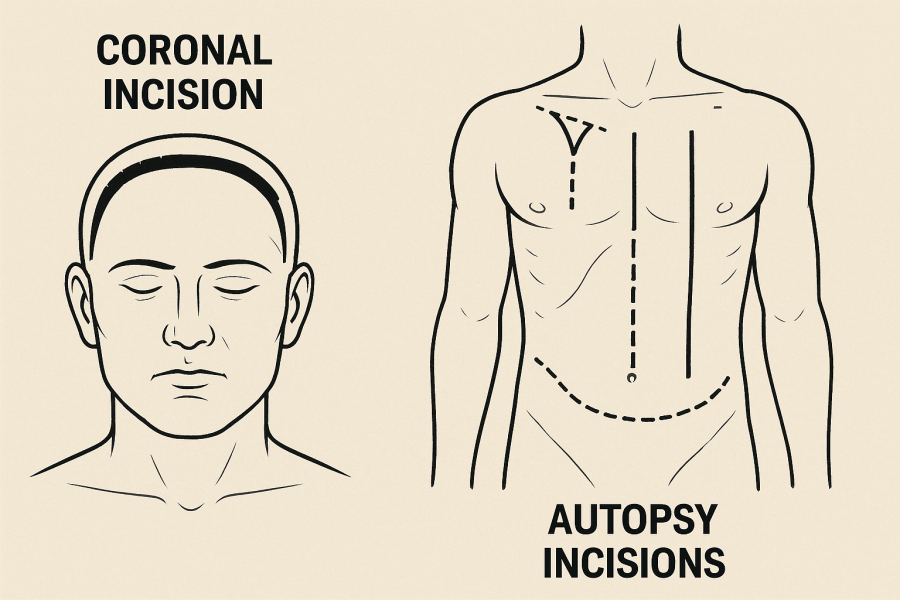
- I-shaped incision: A straight incision is made from the chin (symphysis mentis) to the pubis (symphysis pubis). It is the most common method used.
- Y-shaped incision: it begins at a point close to the acromial process and extends down below the breast and then medially across the xiphoid process. A similar incision is made at the opposite side of the body and from the xiphoid process the incision is carried downwards in a straight line to the pubis.
- Modified Y-shaped incision-a straight incision from sternal notch to pubis is made. Now this incision is extended from the suprasternal notch to the mid-point of the clavicle and then upwards towards the neck behind the ear. A similar incision is made on the opposite side.
Autopsy Techniques
Autopsy techniques define how organs are dissected and examined. Common methods include:
- Virchow’s Method: One organ at a time
- Letulle’s Method: All organs removed as a single mass
- Ghon’s Method: Organs removed in blocks
- Rokitansky Method: Dissection is done in situ (within the body)
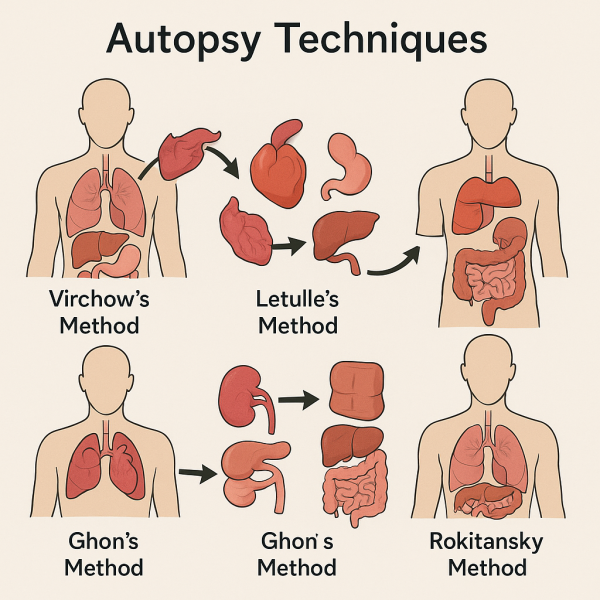
The Rokitansky Method is especially relevant in cases with infectious diseases to minimize exposure.
Advantages and disadvantages of various incisions
| Types of Incision | Advantages | Disadvantages |
| 1-Shaped Incision |
|
|
| Y-Shaped Incision |
|
|
| Modified Y-Shaped Incision |
|
|
Understanding forensic autopsy and its various dimensions – incisions, techniques and types is indispensable for aspiring doctors, especially for those preparing for NEET PG. With medico-legal implications being the strong focus in forensic medicine structured preparation will help you crack high-yield questions confidently.
Frequently Asked Questions:
- What are the different types of incisions in autopsy?
Autopsy incisions are categorized by their shape and purpose. The most common incisions are I-shaped, Y-shaped, and Modified Y-shaped, used for opening the thoracic and abdominal cavities. An X-shaped incision can be used to assess hidden subcutaneous haemorrhages, and a coronal incision is used to access the cranial cavity.
- What are the different types of autopsy?
Autopsies are broadly classified into two main types: forensic and clinical, with several subcategories within each. Forensic autopsies, also known as medico-legal autopsies, are conducted in cases of sudden, unexpected, or unnatural deaths to determine the cause and manner of death, often for legal purposes. Clinical autopsies, also called pathological autopsies, are performed to study the cause of death for research or educational purposes, or when the family requests it.
- What are the six forensic categories of death?
The classifications are natural, accident, suicide, homicide, undetermined, and pending.
- What are the two stages of autopsy?
An autopsy is performed in two different phases—an external examination and an internal one. In the first phase, McDonald explained, the forensic pathologist will note any identifying characteristics and any obvious signs of natural disease.